
Social Insecurity
Social Insecurity
July 30, 2026
Lately you’ve probably heard, seen or read that social security will have to decrease payments by 22% starting around 2033. This begs the question,”is social security a success or a failure?” I contend it has aspects of both and some suggestions to make it more sustainable since so many people, who paid into it by the rules, rely on it. But first, there are several reasons it got here (or is getting there) and some of them may not be what you think.
Its funding and payout mechanisms are actually two intertwined Ponzi schemes, where current investors/taxpayers pay for past investments/earned benefits. People have been arrested for such schemes that are not endorsed and managed by the government.
- Ponzi #1) During times when more is paid in than is paid out, social security buys interest earning treasury bonds using the excess. Just like with any other treasury bond that money goes into the general fund and in its place is an IOU. If you read the congressional budget offices’ (CBO) descriptions of social security, you’ll read words like trust, special, faith, etc. But regardless of the sugar-coating, it’s just an IOU and when the bond is “cashed-in” the money has to come from somewhere (because it’s already been spent) and that is either from borrowing, printing and/or taxes (which all come from you).
- Ponzi #2) During times when there is equilibrium or more is paid out than paid is in, current taxpayers foot the bill….to provide a “benefit” based on money already paid in and taxes that were previously paid.
- These schemes are not sustainable and most people with a good sense for sustainable businesses, companies, finances and economics don’t actually pursue these schemes. That’s because these were developed by people without this “sustainability” experience who think government is the solution to everything. Remember the government does not create value or an economy, the people do. Frances Perkins, surely a well-meaning lady, was the architect of social security in the early 1930s with a background we would call a social justice warrior today.
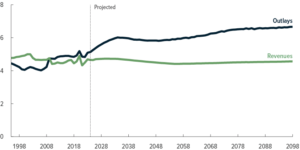
- Right now, there are Democrats and Republicans discussing reforms. Keep in mind that government borrows (and prints) to cover lots of general fund items so why not here? Huh! There is an expectation for changes but this issue has been known a long time with nothing done to address it except for some changes back during the Ronald Reagan presidency where the full retirement age was lifted from 65 to 67 along with other changes designed to extend sustainability. The following chart from the CBO (CBO’s 2024 Long-Term Projections for Social Security | Congressional Budget Office) shows the imbalance exists right now. There is already a shortfall regarding pay out vs pay in but the difference in 2033 is that the shortfall can’t be made up by cashing-in bonds (the IOU called the trust fund) as they will have been consumed. The y-axis is trillions of dollars.
- The methods proposed may improve sustainability, but they come at a cost which may produce drag and the result is only temporary. As one can surmise, the Democrats are using fear to get in a new tax in this situation. How do they accomplish a new tax? Here’s the con, err plan. Someone named Warren is proposing to lift the income limit under which social security tax is paid. Presently, people who earn above this limit don’t pay any more social security tax but they don’t get any more benefit either. The Democrats couch this as not paying their fair share. So few people earn income over this upper limit relative to people under this limit, that the net result is meager. But it’s worse than that. People who earn over this upper limit (which adjusts upward with inflation every year) also pay a lot more in “income” taxes than people under this limit. The available deductions decline and the tax rate goes up. They are already paying their fair share. Shameless! But it gets even worse than that. The question is, “do these higher earners now get social security benefits based on all of their income and social security taxes paid or not?” Because if they don’t get any more benefit for paying into social security on income now above the former upper limit, it’s just a new tax. Wait, whether they get this benefit or not, there’s already a way to make this a new tax. Also being proposed is a cap on the benefit or payout and this number is around $2000 per month. If you paid the taxes for decades and your benefit was computed to be above about $2000 (maybe it’s as high as $4,000 or even $5,000) and you just get $2000, you got hit with a massive retroactive tax and your retirement planning is a shambles because social security is an important part of retirement for most of us.
- Now, we’re told that this is a demographic problem but this only part of the issue. According to U.S. National Debt Clock : Real Time (which uses US Government Agency information), there are right now 109 million US adults who aren’t working. Eight million adults are considered disabled (although some may be working) and 63.5 million adults are retired. That leaves 37.5 million adults who aren’t working and paying into the social security system. The same people who are political descendants of social security’s creation, who love doling out welfare and other goodies (from an indebted government), who are generally anti-business which means job creation suppression and who are behind the idea of universal basic income (stay at home, get a check) are supposed to be rescuing the system. These people have put up barriers to and disincentivized working for a living. Policies that remove barriers and incentivize working will get 10s of millions people into the work force who are now paying into the social security system and giving it more of a chance at sustainability without the “we need a new tax” crowd. That’s a real part of the solution.
Social security is unsustainable and must be changed. Many people rely on it and I paid into it and expect the benefit that was earned according to the rules that I worked under. So do you. While it has helped to keep seniors out of poverty (a success), it was never built to be sustainable (a failure). Here are some thoughts on its continuation.
1) get more people working
2) ok, adjust the earliest and full retirement ages up 6 months but graduate implementation over 10 years so people can plan
3) this is difficult to propose because the federal government really should not own private sector assets but, take a small percentage of
what’s paid in and start investing into a distribution of assets with rules to hold for a minimum of 2 yrs. and a maximum of 15 yrs. to
ensure assets end up back in private sector or non-federal government hands and profits are realized which go into social security
3.a. this could be 1% invested at year 1 and 2% at year 2, continuing until you get to 50%
3.b. the investment distribution can include real estate, metals, commodities, stocks, bonds (non-federal), start-up ventures, etc.
and is led by a market/business/investor experienced board (independence and lack of conflicts are important)
3.c. as investments are sold, the principal and profit go into social security
3.d. evaluate the investment component periodically and put a sunset on it once social security looks sustainable for many decades
Tell them not to touch the taxable income limit and don’t lop off benefits. Stop believing the fearmongers who created the problem, claiming they are going to fix the problem but are really just creating new taxes. Stop voting for them too.