
An Important Win
An Important Win
April 27, 2026
Whether or not you agree with the US-Israel-Gulf States-Iran war, the US and Iran are now engaged in a hot military conflict which, at this point, the US needs to win. Iran is a multi-decade supporter of terrorism against the US and its allies, killing thousands. It is actively trying to acquire a nuclear weapon, not as a statue, but to kill even greater numbers of Americans and their allies. It has always threatened to close the Strait of Hormuz, an international waterway, thereby closing access to vital energy, fertilizer and pharmaceuticals. It has terrorized a large portion of its own population, perhaps a majority of it. There’s no democracy, free speech, freedom of religion, women’s rights or gay rights in Iran, for those of you who aren’t sure.
But what does “win” mean. It seems to me that the definition of win entails the following and one must have a strategy in place to handle every one:
- destroy the military capability
- eliminate the ability to make a nuclear weapon (any time soon, i.e., next 15 years or longer)
- protect the Strait of Hormuz (or Vermouth, it’s your choice apparently depending on how you like your martini)
- support US friendly and Iranian Peoples friendly rebel groups which take over the country and establish an interim government (not sure if elections come immediately after or not but this can be a goal perhaps with a new republic and freedom-loving constitution as well)
It’s not clear any of these have happened despite the rhetoric. But they can happen and solutions are suggested for each.
Number 1:
Destroy the Air Force, anti-air capability, Navy, anti-ship capability, missiles and their launchers, large artillery pieces, tanks, armored vehicles and drones as well as manufacturing and maintenance facilities. This is mostly achievable but does not destroy the entire military. Large Iranian ground forces are still present and can move around even if by foot, camel, horse, moped or bicycle. Furthermore, there are still attacks in the Strait of Hormuz and elsewhere so this goal has definitely not yet been mostly achieved and there is still work to do here.
Number 2:
It has been stated, although we may not be privy to accurate information, that there is still enriched uranium that needs to be controlled. Let’s say that’s true. Does it? While not an environmentally-friendly approach, why can’t this be bombed and scattered and that area monitored by satellites with no one allowed to approach without consequences? Maybe by now the stockpile has been split into 20 separate storage locations. This can still be bombed. No US personnel need to be put at risk here. Maybe this one is close to achievement given the above recommendations. If number 4 is successful then US personnel might have safer access to this material.
Number 3:
This is so obvious a cavemen can see it (and I do apologize to cavemen everywhere for using you in this article because I know you are far more capable than the stereotype we’ve created). Hundreds of cargo ships and tankers were passing in each direction every day before the conflict. Today, the traffic is not even 1/10th and supposedly the Iranians (or Islamic Revolutionary Guard Corps – IRGC) have turned this into a blockade and profit-making venture, allowing select vessels through with payment. The US has decided to blockade the blockade. Well, since we destroyed their military, it should be no problem to do the following to keep the Strait open, even during negotiations:
- remove mines and keep destroying minelayers, which might be as small as a rowboat
- focus on the destruction of every military capability in a zone within a 50 mile radius of the center of the Strait (anything launched from outside this distance conceivably can be picked up by surveillance in time to destroy it)
- patrol the strait with aircraft, helicopters, drones and naval vessels (is any US military within this 50 mile zone?)
- the US can still blockade Iran associated shipping
Shipping right now should be at least 50% of the traffic before the war and growing.
Number 4:
This is the one that just doesn’t compute yet. At the start of this war the US should have had an insurgency in place with funding, supplies along with air/naval support and cover. I can think of the ideal locations to start this insurgency which has the following attributes:
- local population hatred of the central government and IRGC
- accessibility by drone and other means for supplies from the US military
- proximity to the Strait of Hormuz
- relationship building between external and internal leadership providing communications between Iranian rebel forces on the ground and US military/intelligence
- rapid air/naval cover for rebel forces moving against the Iranian military and IRGC
With success on the ground, the Strait of Hormuz will be increasingly inaccessible to the Iranian military and IRGC. In addition, other rebel groups are emboldened with the goal of expanding forces and moving against Tehran and other strategic locations at some point. This just makes sense.
What are those locations? Here’s a map of Iran from MapNations. Keep in mind I have no access to any government or inside information. This region is outlined with red circles and interconnecting red lines.
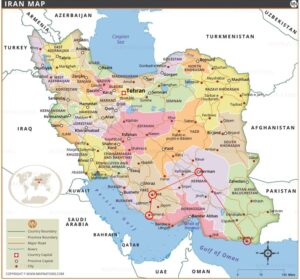
The noted region forms an arc from Lamerd to Fasā in Fars to Kerman in Kerman to Chābahār in Sistan and Baluchestan. Not sure why this region is not in a funded, supplied and US military covered uprising right now but this is a start.
Notice successful negotiations weren’t mentioned. Prior US adminstrations and other world entities have tried this and the Iranians simply lied. Surely former politicians and administration officials knew that. I have also not mentioned NATO or the son of the former Shah. NATO can’t be depended on for much here, even though in the long run, if the US wins, there is a benefit to those countries. It’s not clear that the son of the Shah (the Shah was overthrown in the Iranian Revolution of 1979) has enough support to form a coalition that can win militarily and come together to form an interim government. It might be possible but I think this might take several individuals and groups, mostly inside of Iran, to form that winning coalition.
Note that there are US politicians and prior administration officials from both parties that recognized the threat of Iran and have proposed military action. Now a President has done just that but we have to take a hard look at the strategy to win and have suggested some solutions.